Manufacturing technologies at QNL Plastics
At QNL Plastics we combine years of experience with advanced production techniques. Whether you're looking for large-scale mass production or a high-quality prototype, we advise you on the most efficient production method for your specific requirement.
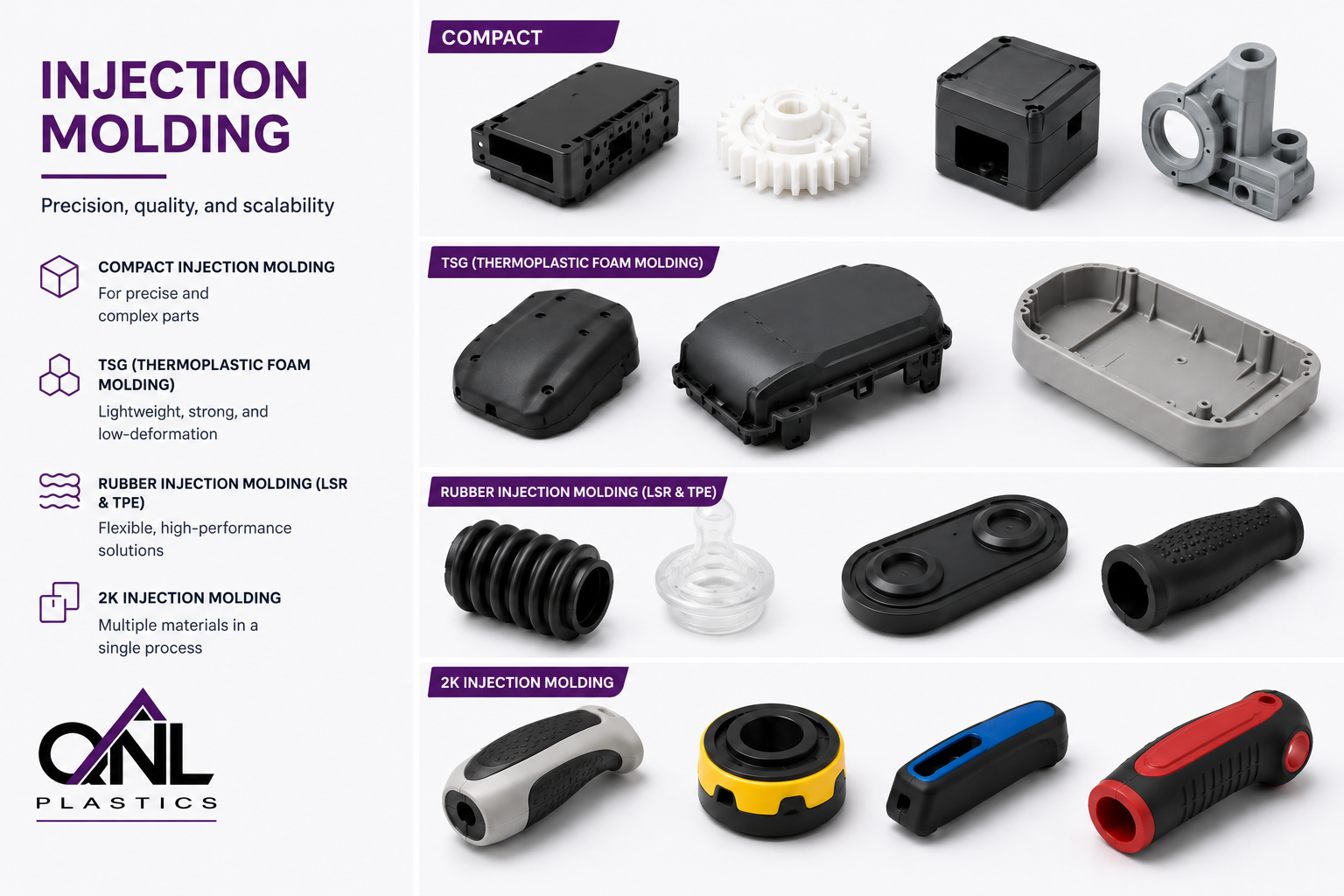
Injection moulding: the standard for precision
Injection moulding is the most widely used technique for high-quality plastic components. Molten plastic granulate is injected under high pressure into a steel mould, resulting in a solid, dimensionally stable end product.
- Standard (Compact) Injection Moulding: Ideal for mass production with high repeatability, from detailed components to larger housings.
- SFM (Structural Foam Moulding): A technique using lower injection pressure, ideal for large, robust housings. It prevents sink marks in thick-walled products and saves weight thanks to the foamed core.
- Rubber Injection Moulding (including LSR & TPE): For flexible components. We apply classic vulcanisation (for heat resistance), LSR (for precision/medical applications) and TPE (for recyclable rubber-like plastics).
- 2K Injection Moulding: Produces a composite product from two materials or colours in a single step, such as a hard housing with a soft, anti-slip grip. This saves on assembly costs and guarantees a perfect seal.
Extrusion and Co-extrusion
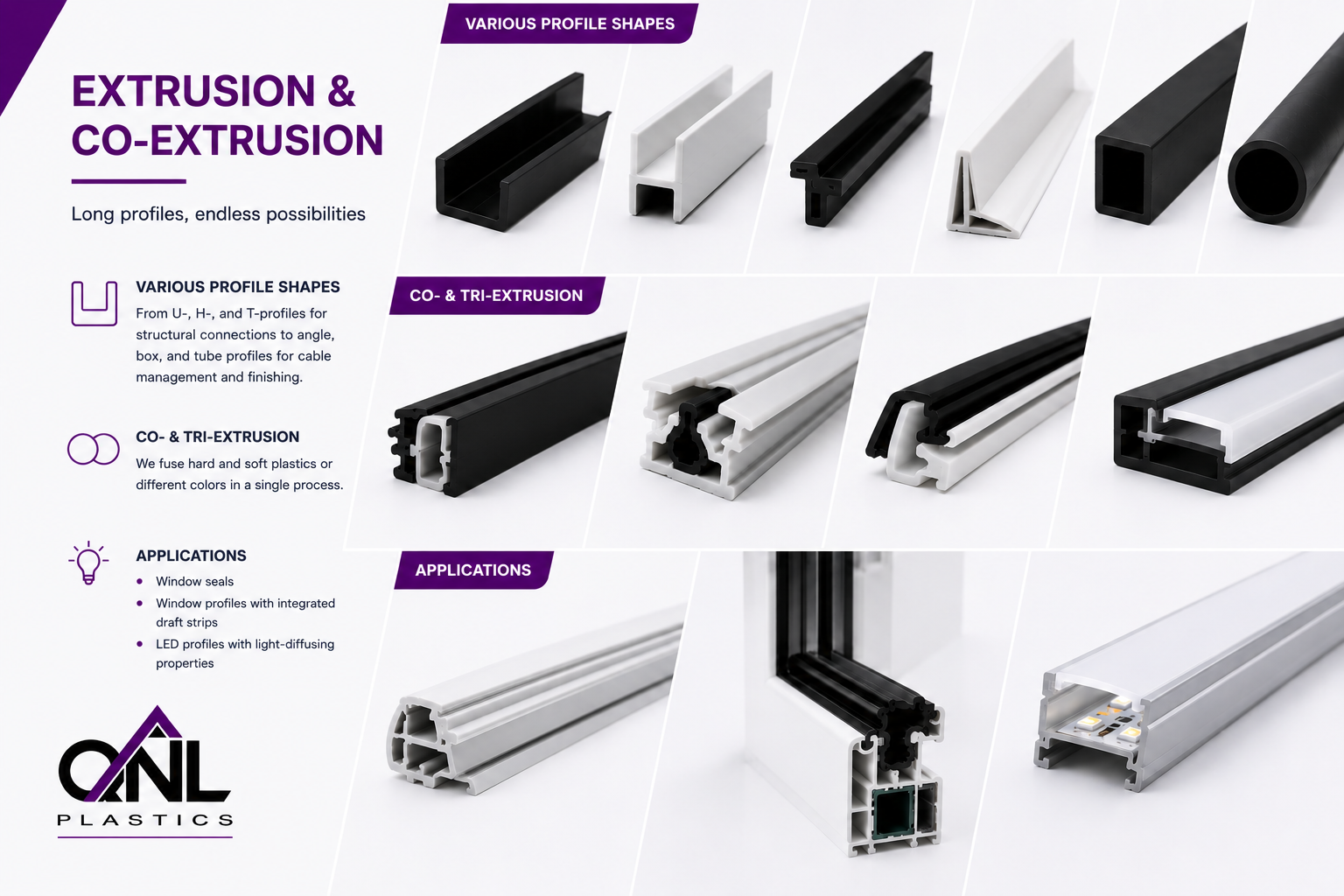
For long, continuous profiles we offer extensive extrusion capabilities.
- Various profile shapes: From U-, H- and T-profiles for structural connections to corner, box and tube profiles for cable management and finishing.
- Co- and Tri-extrusion: We combine rigid and flexible plastics, or different colours, in a single process.
- Applications: Think of refrigerator seals, window profiles with integrated weather strips, or complex LED profiles with light-diffusing properties.
Hollow structures: Rotational moulding & Blow moulding
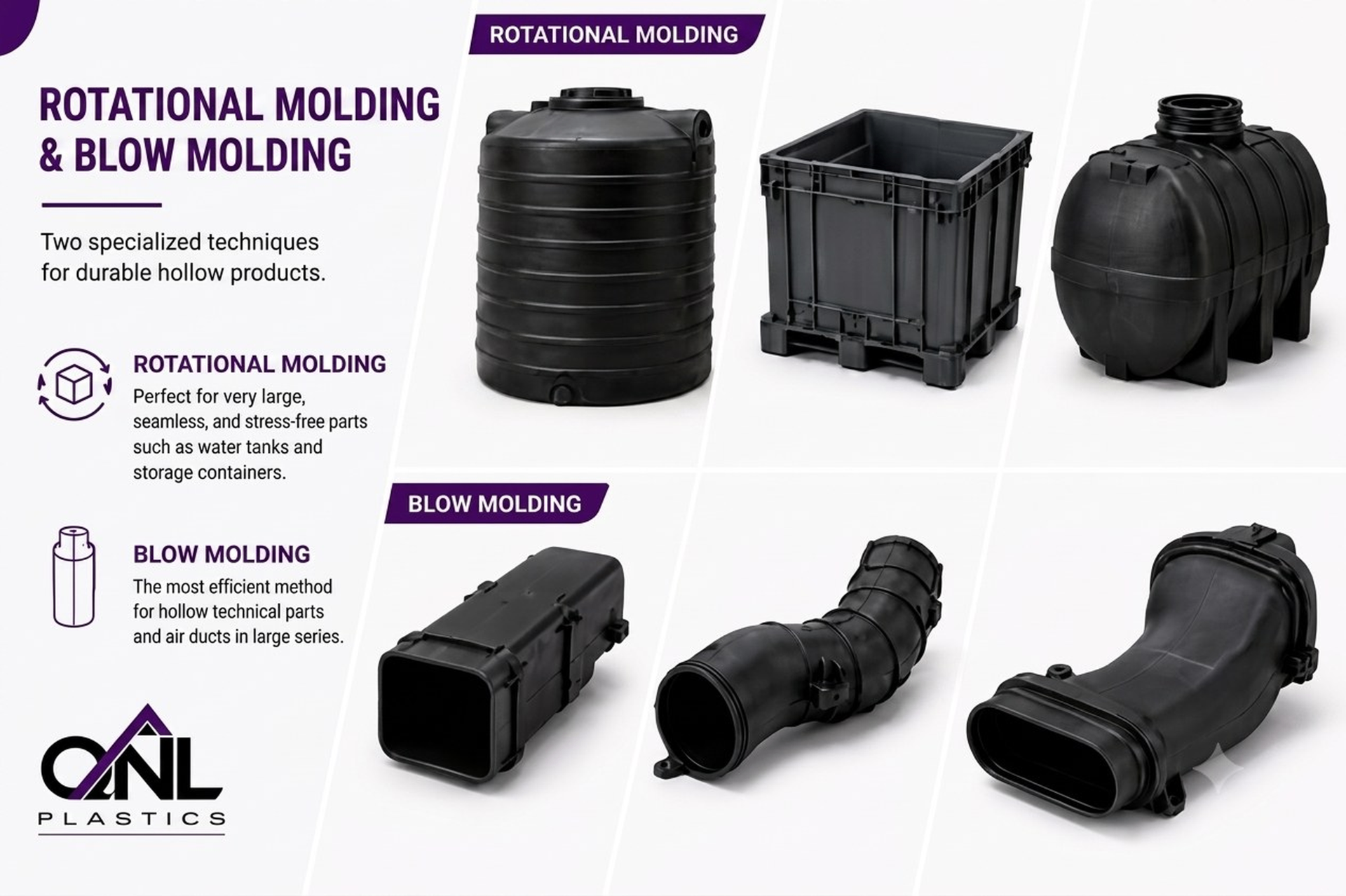
For producing hollow plastic products we apply two specialised techniques.
- Rotational moulding: Perfect for very large, seamless and stress-free objects such as water tanks or storage containers.
- Blow moulding: The most efficient method for hollow packaging and technical air ducts in large series.
Thermoforming & Vacuum forming
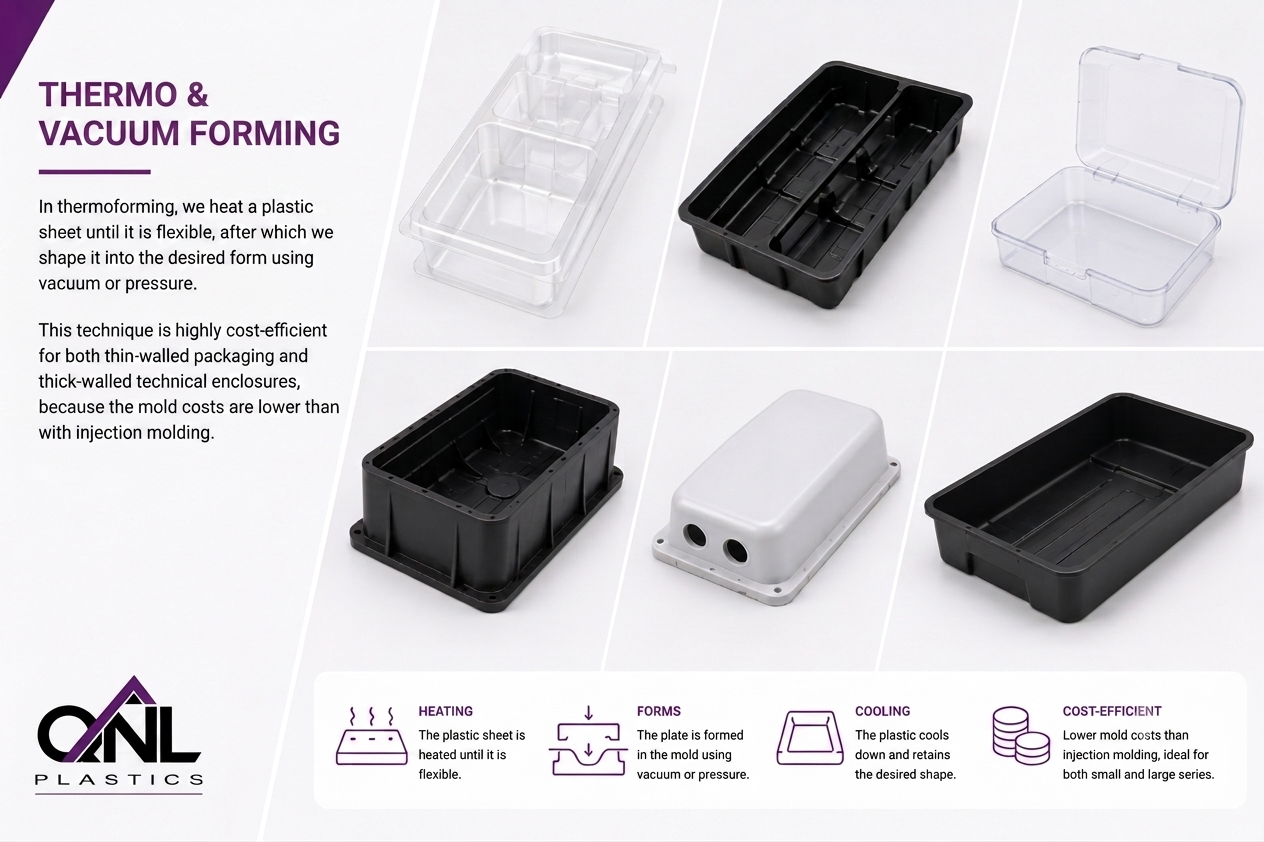
In thermoforming, a plastic sheet is heated until it becomes flexible, after which it is shaped using vacuum or pressure. This technique is highly cost-efficient for both thin-walled packaging and thick-walled technical housings, because tooling costs are lower than with injection moulding.
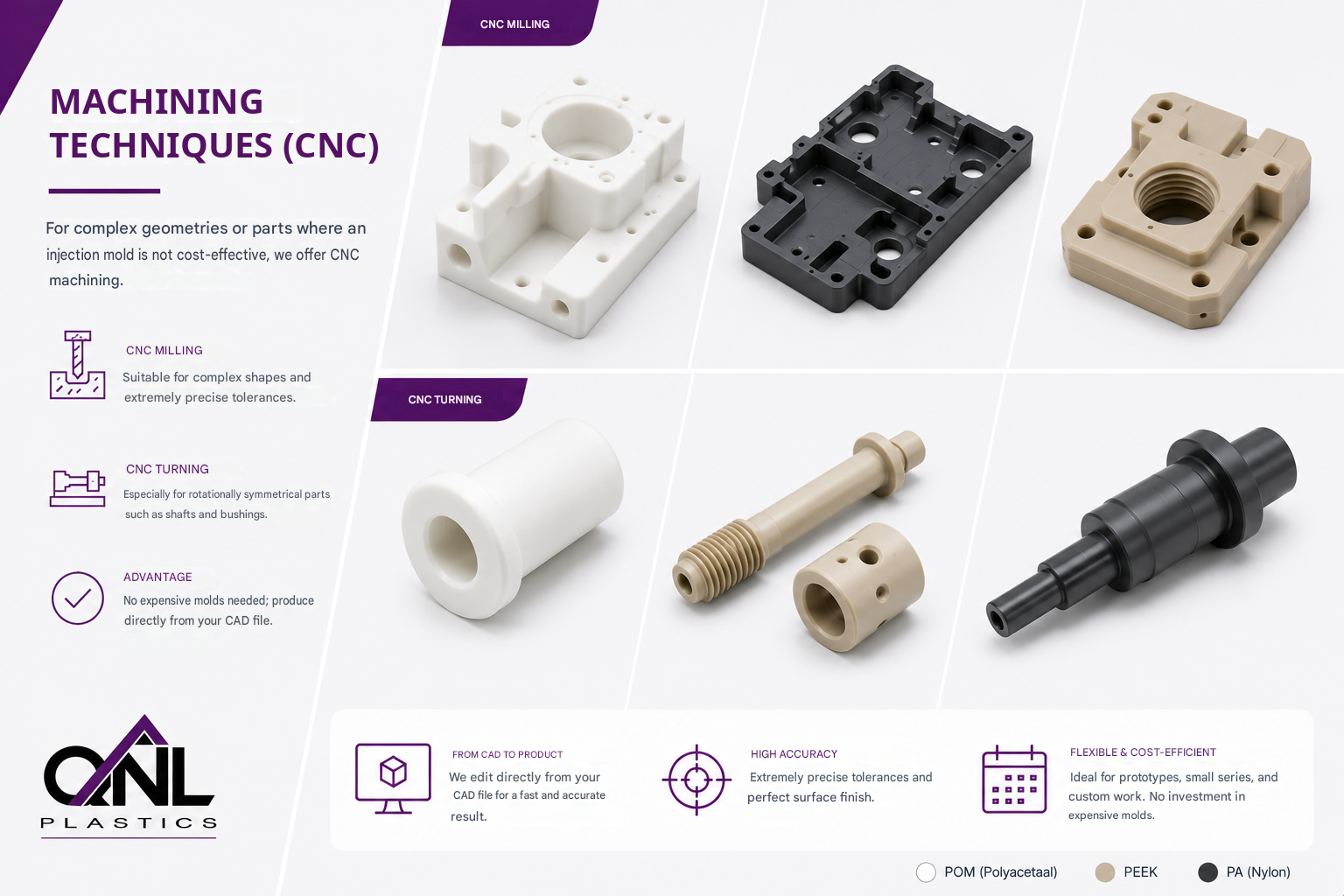
Machining techniques (CNC)
For complex geometries or components where an injection mould isn't cost-effective, we offer CNC machining.
- CNC Milling: Suitable for complex shapes and extremely tight tolerances.
- CNC Turning: Specifically for rotationally symmetrical components such as shafts and bushings.
- Advantage: No expensive moulds required — produced directly from your CAD file.
Additive Manufacturing (3D printing)
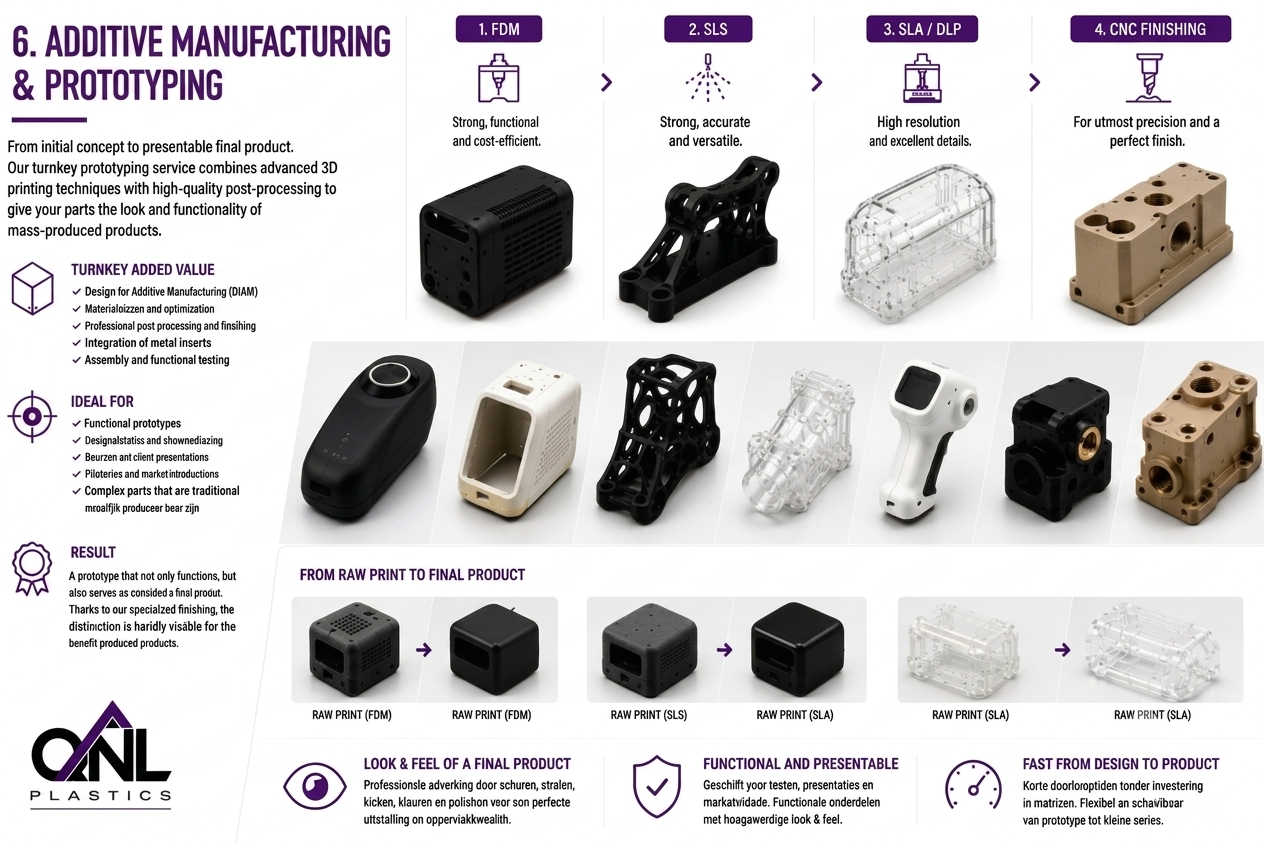
Manufacturing technologies: FDM | SLS | SLA | DLP | CNC post-processing
Turn-key added value: We deliver prototypes with the exact look and quality of an end product. Our service includes:
- Engineering: DfAM & material advice
- Finishing: Sanding, blasting, painting, colouring & transparent finishing
- Assembly: Metal inserts, branding & complete product assembly
Ideal for: Functional & design validation, show, trade-fair and presentation models, pilot series & complex components.
The result: A functional prototype that's indistinguishable from a series product in look, feel and detail.
Tailored advice
Looking for the best manufacturing technique or the right material for your product? We support you in finding the optimal balance between cost, material selection and quality.
Have your design reviewed for manufacturability? →