Plastic & Rubber materials
At QNL Plastics, we work with a wide range of thermoplastics, elastomers and high-performance plastics. Depending on your application, we advise on the most suitable material based on mechanical load, chemical resistance, temperature, regulatory requirements and cost.
Because we collaborate with various renowned international raw material suppliers, material properties may vary by grade. The information provided should therefore be considered general guidance.
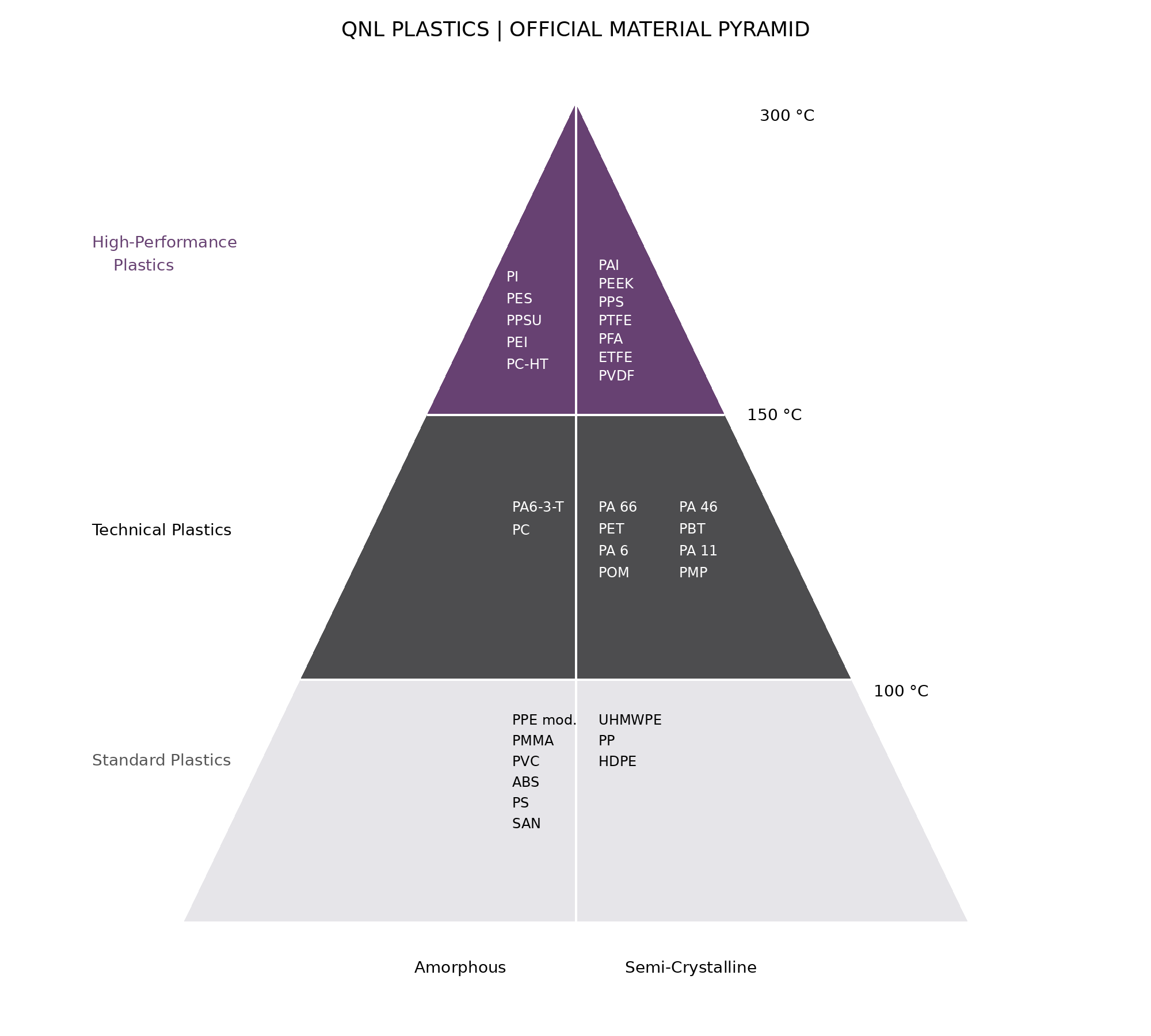
Material categories Plastics
Cost-efficient materials for general technical applications.
For applications with higher demands on strength, wear resistance and dimensional stability.
For extreme conditions such as high temperatures, aggressive chemicals or medical applications.
Material pyramid Plastics
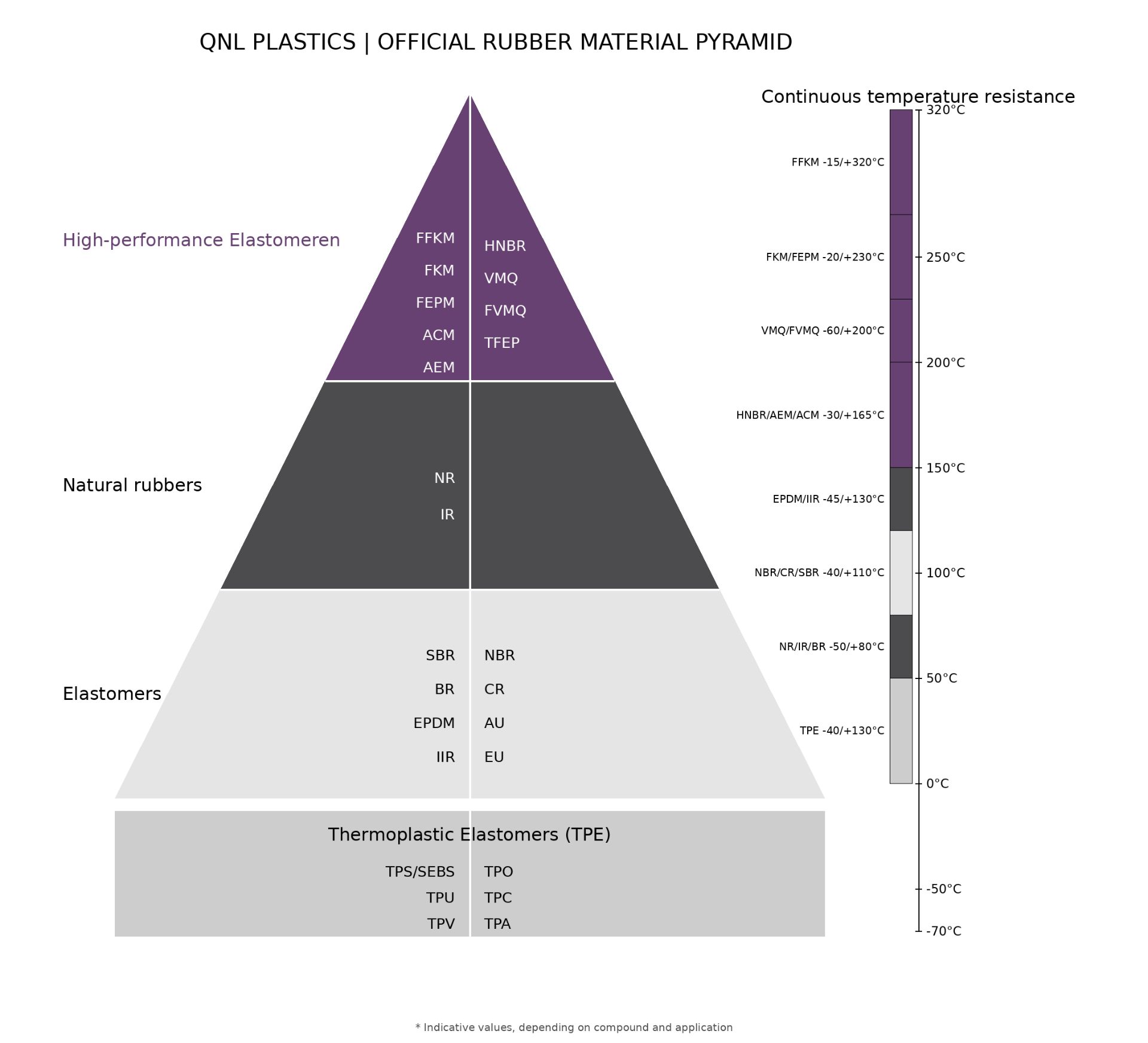
Material categories Rubbers
Flexible materials for sealing, damping and dynamic applications where elasticity is essential.
Thermoplastic elastomers (TPEs) form an important subgroup within the elastomer family. These advanced materials combine the flexibility and elasticity of rubber with the processing advantages of thermoplastics, enabling efficient production of complex components.
Widely used elastomer with excellent elasticity, high tensile strength and good wear resistance. Suitable for dynamic applications where flexibility and mechanical performance are important.
Origin: Derived from the latex of the rubber tree (Hevea brasiliensis).
Properties: Excellent elasticity, high tensile strength, good wear resistance and outstanding dynamic properties.
Advanced elastomeric materials developed for demanding applications involving extreme temperatures, aggressive chemicals, high mechanical loads or stringent regulatory requirements. Suitable for applications where standard rubber materials do not provide sufficient performance.
Applications: Sealing, damping and protection in harsh operating environments.
Properties: Excellent resistance to heat, chemicals, weathering, ageing and mechanical stress.
Material pyramid
Materials table
For detailed material specifications, see below:
| Material | Structure | Injection moulding shrinkage (%) | Temp. min (°C) | Temp. max (°C) | Mechanical properties – tensile | Mechanical properties – compressive | Chemical resistance | Application area |
|---|---|---|---|---|---|---|---|---|
| LDPE | Semi-crystalline | 1.5–4.0 | -50 | 80 | Tensile strength approx. 8–20 MPa; low stiffness; high elongation | Low compressive strength; creep-sensitive | Very good against water, acids and bases; moderate against oils/hydrocarbons | Films, bottles, caps, flexible packaging |
| HDPE | Semi-crystalline | 1.5–3.5 | -50 | 100 | Tensile strength approx. 20–35 MPa; tough; higher stiffness than LDPE | Compressive strength approx. 20–30 MPa; creep under load | Very good against acids, bases and many solvents; UV stabilisation required outdoors | Crates, pipes, tanks, containers, technical sheets |
| PP | Semi-crystalline | 1.0–2.5 | 0 | 120 | Tensile strength approx. 25–40 MPa; low density; good fatigue resistance | Compressive strength approx. 35–55 MPa; creep-sensitive when warm | Very good against acids/bases; limited against aromatics and chlorinated solvents | Living hinges, automotive parts, housings, lab components |
| PS / HIPS | Amorphous | 0.3–0.7 | -10 | 80 | Tensile strength approx. 20–45 MPa; PS brittle, HIPS more impact-resistant | Compressive strength approx. 50–90 MPa | Moderate; sensitive to many organic solvents | Packaging, disposable items, displays, interior parts |
| PVC-U | Amorphous | 0.2–0.6 | -10 | 80 | Tensile strength approx. 40–60 MPa; good stiffness | Compressive strength approx. 55–80 MPa | Very good against acids, bases and salts; poor against ketones/aromatics | Pipes, profiles, chemical piping, sheets |
| ABS | Amorphous | 0.4–0.8 | -20 | 100 | Tensile strength approx. 35–55 MPa; good impact resistance | Compressive strength approx. 60–90 MPa | Moderate; sensitive to solvents; reasonable against dilute acids/bases | Housings, automotive interiors, consumer goods |
| PA6 / PA66 | Semi-crystalline | 0.8–2.2; lower for GF grades | -40 | 150 | Tensile strength approx. 60–90 MPa; strongly moisture- and grade-dependent | Compressive strength approx. 80–120 MPa | Good against oils and fuels; sensitive to moisture, strong acids/bases | Gears, bearings, clips, machine parts |
| POM / acetal | Semi-crystalline | 1.5–2.5 | -40 | 120 | Tensile strength approx. 60–75 MPa; high dimensional stability; low friction | Compressive strength approx. 90–120 MPa | Good against fuels, oils and solvents; poor against strong acids/oxidisers | Precision parts, gears, sliding parts, closures |
| PC | Amorphous | 0.5–0.7 | -40 | 130 | Tensile strength approx. 55–70 MPa; very impact-resistant; transparent grades available | Compressive strength approx. 80–100 MPa | Moderate; sensitive to stress cracking from solvents | Transparent parts, lenses, protective covers, housings |
| PMMA | Amorphous | 0.2–0.8 | -40 | 100 | Tensile strength approx. 50–75 MPa; high optical quality; more brittle than PC | Compressive strength approx. 90–120 MPa | Reasonable against water and UV; sensitive to solvents | Optical parts, displays, light guides |
| PBT / PET | Semi-crystalline | PBT 1.2–2.5; PET 0.2–3.0; lower for GF grades | -40 | 150 | Tensile strength approx. 50–90 MPa; GF grades much higher | Compressive strength approx. 80–130 MPa | Good against oils, fuels and many chemicals; hydrolysis-sensitive at high temperature/humidity | Connectors, electrical parts, automotive, dimensionally stable components |
| PPE/PPO, mPPE | Amorphous | 0.5–0.8 | -40 | 120 | Tensile strength approx. 50–75 MPa; good dimensional stability | Compressive strength approx. 80–110 MPa | Good hydrolysis resistance; moderate against aromatics/ketones | Electronics, pump parts, water technology, housings |
| PEEK | Semi-crystalline | 1.0–1.5; lower for GF/CF grades | -60 | 260 | Tensile strength approx. 90–110 MPa; GF/CF grades higher; high creep resistance | Compressive strength approx. 120–150+ MPa | Excellent; very good against hydrolysis, oils, fuels and many chemicals | Aerospace, medical implants, oil/gas, bearings, seals |
| PPS | Semi-crystalline | 0.6–1.2; lower for GF grades | -40 | 240 | Tensile strength approx. 70–100 MPa; high dimensional stability at elevated temperature | Compressive strength approx. 100–150 MPa | Excellent against solvents, fuels, acids and bases | Electronics, under-bonnet automotive, pumps and valves |
| PEI / Ultem | Amorphous | 0.5–0.8 | -50 | 180 | Tensile strength approx. 90–110 MPa; high stiffness; inherently flame-retardant | Compressive strength approx. 120–160 MPa | Good; sensitive to some chlorinated/aromatic solvents | Electronics, medical sterilisation, aircraft interiors |
| PSU / PES / PPSU | Amorphous | 0.5–0.8 | -50 | 180 | Tensile strength approx. 70–95 MPa; good toughness; PSU/PPSU hydrolysis-resistant | Compressive strength approx. 100–140 MPa | Good against hydrolysis, steam and cleaning agents; moderate against solvents | Medical, food/water, sterilisation, pump components |
| PVDF | Semi-crystalline | 1.5–3.0 | -40 | 150 | Tensile strength approx. 35–55 MPa; tough; good ageing resistance | Compressive strength approx. 60–90 MPa | Excellent against acids, halogens and many chemicals; suitable at higher temperatures than PP | Chemical piping, tanks, membranes, semiconductor |
| PTFE | Semi-crystalline | 2.0–5.0; depends on sintering process | -200 | 260 | Tensile strength approx. 20–35 MPa; low friction; low wear resistance unfilled | Low to moderate compressive strength; strongly creep-sensitive | Exceptionally inert; resistant to almost all media except a few highly reactive ones | Seals, liners, plain bearings, chemical lining |
| LCP | Semi-crystalline / liquid-crystalline | 0.1–0.6; anisotropic | -40 | 240 | Tensile strength approx. 100–180 MPa; highly direction-dependent | High, but anisotropic and grade-dependent | Very good; low moisture absorption | Thin-walled connectors, SMD, micro-precision |
| PAI / PI | Predominantly amorphous / imide | 0.5–1.0; process-dependent | -200 | 300 | Tensile strength approx. 90–150 MPa; very high heat and wear resistance | Compressive strength approx. 150–250 MPa | Very good; suitable for high temperatures and wear | Aerospace, bearings, compressor/pump parts, extreme wear |
| TPE-S / SEBS | Multiphase block copolymer | 0.8–2.5 | -50 | 120 | Tensile strength approx. 3–20 MPa; high elongation; hardness strongly determines behaviour | Use compression set rather than classic compressive strength | Good against water, acids and bases; moderate against oils/fuels unless modified | Soft-touch grips, seals, overmoulding on PP/PE, consumer products |
| TPU | Multiphase thermoplastic elastomer | 0.5–1.5 | -40 | 120 | Tensile strength approx. 20–50 MPa; very high wear resistance | Assess via compression set and deformation under load | Good against wear, oils and greases; polyester-TPU can be hydrolysis-sensitive | Wheels, hoses, cable sheathing, technical elastomer parts |
| TPV | PP/EPDM, dynamically vulcanised | 1.0–2.5 | -60 | 135 | Tensile strength approx. 3–15 MPa; rubber-like behaviour | Low to moderate compression set; better than many TPE-S grades when warm | Good against water, acids/bases and weathering; moderate against oil/fuel | Automotive seals, gaskets, rubber substitute, cables |
| TPO | Polyolefin elastomer; semi-crystalline | 1.0–2.5 | -40 | 110 | Tensile strength approx. 5–25 MPa; impact-resistant and lightweight | Moderate; creep-sensitive | Good against water and many chemicals; moderate against oils/aromatics | Bumpers, interior parts, films, soft PP applications |
| Silicone / VMQ | Crosslinked elastomer, amorphous; not a thermoplastic | Mould shrinkage approx. 1–4; process-dependent | -60 | 230 | Tensile strength approx. 5–12 MPa; high elongation; retains properties at low/high temperature | Assess via compression set; often good over a wide temperature range | Excellent against UV, ozone, water and temperature; moderate against fuels/oils and concentrated acids/bases | O-rings, medical parts, food contact, cables, high/low-temperature seals |
Material advice
The right choice of material often determines a product's performance, lifespan and cost. That's why we're happy to advise you on the most suitable plastic based on your application, loads, environment, regulations and production process.
Torn between, say, POM, PA, PET-P or PEEK? We're happy to help you make the right choice.
Request material advice →